Is a humanoid suited to my task?
This question can be answered before we meet. Below is a list of positions that humanoids fill today, and a list of those where we will talk you out of a deployment.
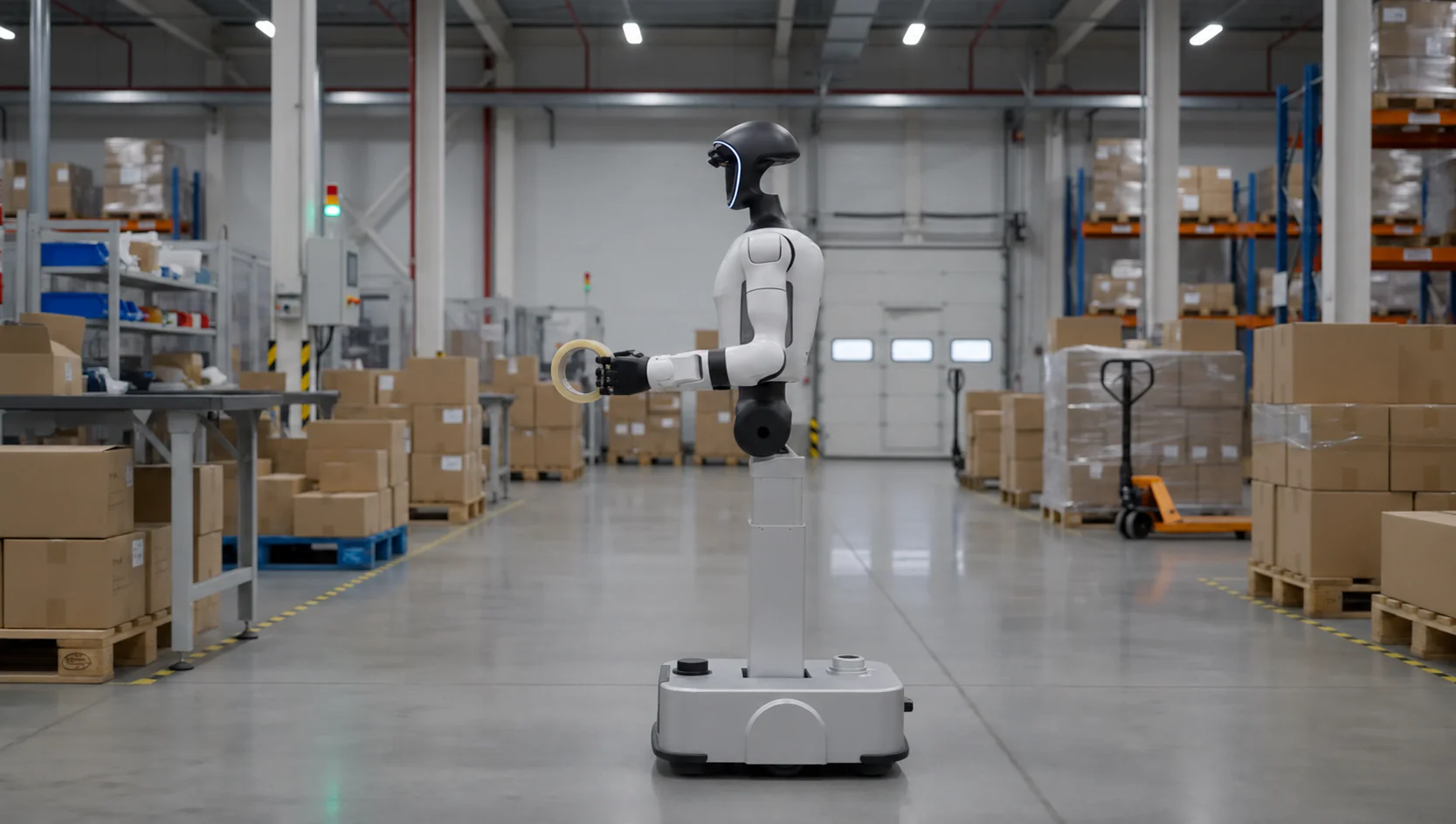
We look for a position, not a single task
We do not ask which movement a robot does faster than a person. We ask which position you have no one to fill, because our model is calculated per filled position, not per second of cycle time saved.
That difference matters: a position tends to be a mix of several activities, moves and waiting, and it is in exactly this mix that a humanoid has the edge over a single-purpose machine.
A practical guide: if the work can be described as “it walks over here, picks this up, carries it over there and checks on the way that it is in order”, it is a candidate. If it can be described as one movement repeated at a cycle time of under a few seconds, it is not a candidate.
What humanoids fill today
Replenishment and machine tending
Feeders, loading parts, removing finished pieces, tending a machine between cycles. A position that has been hard to fill reliably for years, and yet the line stops without it.
Kitting, packing, quality inspection
Packing into boxes, kitting sets, visual inspection. Work where the variants change more often than it pays to rebuild a single-purpose machine.
Service rounds through the operation
Moving around the hall, regular checks, readings, condition monitoring. The robot gets to the spot on its own, and the operator takes it over remotely from the control room when needed.
Work across several stations
Positions where the shift involves moving between several places, none of which has enough work for a full-time job. Of no interest to dedicated automation, ideal for a humanoid.
Cooperative positions alongside people
Tool crib, goods receiving, warehouse. The robot works in the same space as people, which is a matter of the workstation's safety design, not a question of the platform.
Reception and gatehouse
Receiving visitors, issuing access cards, announcing visitors to their host, watching over the entrance hall outside working hours. Most of the shift is waiting between arrivals, so in the meantime the robot does rounds of the building or serves the tool crib, and a conversation that goes off script is taken over remotely by the operator from the control room.
How we find out whether it fits your site
We walk through the operation
Half a day in the hall with you. We are interested in the specific positions, the shift pattern and which of them have been hard to fill for a long time.
We select the positions
From what we have seen, we select those that today's technology can handle, and say why we are leaving out the others.
We answer yes or no
The operation decides. Rental pays where the selected positions run at least 18 hours a day, seven days a week.
- If yes, we send a solution proposal with pricing.
- If not, we tell you so straight and send no quote.
What a humanoid is not suited to
- Highly specialised static operations for which a single-purpose machine can be built. It will be faster, more precise and cheaper, and we will tell you so at the first meeting.
- Tasks requiring extreme precision and a short cycle time. A humanoid is versatile, not more precise than a dedicated manipulator.
- Demanding outdoor, dusty or damp environments without the corresponding platform certification.
- Stations that can only be reached by stairs or over uneven ground. A humanoid torso on a mobile base needs a step-free route.
Do you have a position that would fit here?
Describe it to us in two sentences. If a humanoid is not suited to it, you will hear so straight away.