Documentation for your engineer
This page is written for the person whose job is to say whether this will pass at your site. No marketing: where we do not know something, or it depends on the configuration, that is written here too.
- Machinery Regulation
- 2023/1230
- Applies from
- 2027
1Conformity assessment and CE
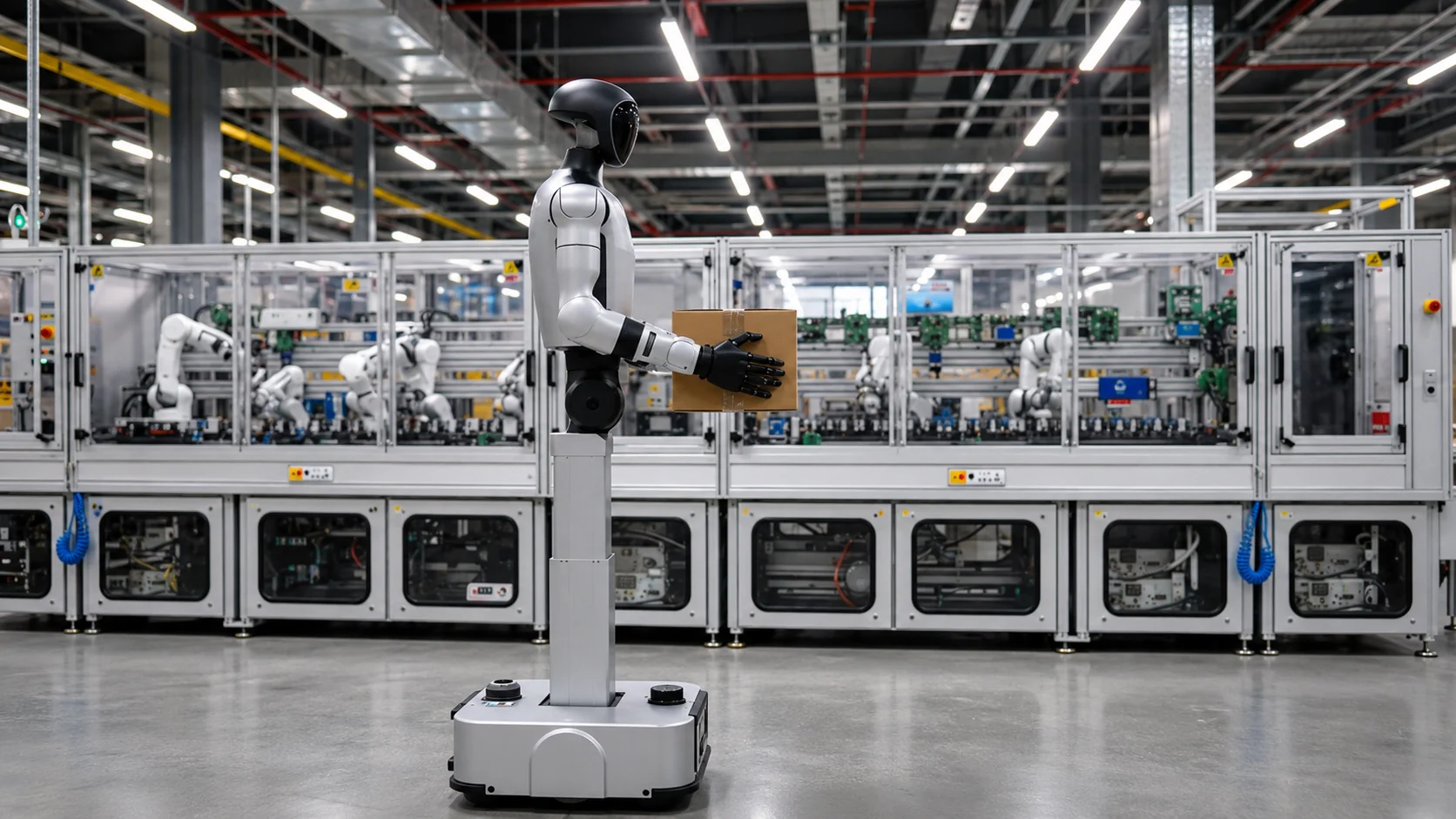
The CE of the humanoid itself is the responsibility of its manufacturer. But once we integrate it into your line, a new assembly is created, a robotic station, and that needs its own conformity assessment. It is not a formality that can be skipped.
We prepare the technical documentation for the station: the risk analysis, the description of safety functions and the operating documentation. The conformity assessment of the whole assembly is then handled together with you, because it affects your line and your existing safety measures.
2What the new regulation changes
The deployments we are preparing today will still be in operation after 2027, when the regulation starts to apply. So we build the documentation to meet its requirements from the start, not to redo it afterwards.
What matters for humanoids is that, for the first time, it explicitly addresses three things that until now had to be inferred:
- Machines with self-learning behaviour, that is, machines whose behaviour changes in operation.
- Cybersecurity of safety functions, not only mechanical safety.
- Digital operating documentation and how it is kept up to date.
Source: Regulation (EU) 2023/1230.
3Station safety
Four things an engineer asks about first.
- Emergency stop
- The robot has its own safety circuit and also responds to signals from your line's safeguarding devices. An emergency stop of the line therefore stops the robot too, and vice versa: a robot stop is passed on to the line.
- Communication with the line
- The robot continuously reads the state of the individual parts of the line and adapts its tasks to it. It is not a blind manipulator that runs its programme regardless of what is happening around it.
- A mobile base instead of legs
- A humanoid torso on a mobile base removes the risk of falling, which is the main obstacle to safety certification for two-legged platforms. The cost is that the robot needs a step-free route; it cannot climb stairs.
- Working next to people
- We handle collaborative positions according to the specific station: by speed, force limits, fencing or a combination. What exactly will be needed follows from the risk analysis, not from a catalogue.
4Cybersecurity and your data
Control runs locally. Decisions about what the robot does are made on your premises, so operation does not go down with an internet outage, and nothing about your production is sent out because of it.
Telemetry and diagnostics go to the cloud: robot status, faults, operating metrics. We use them for service and for updates. We go through the scope of this data with your IT when designing the solution and write it into the contract, so that it is not open to interpretation.
We supply the control app and updates are part of the monthly fee. We deploy updates by agreement with you, not whenever it occurs to us.
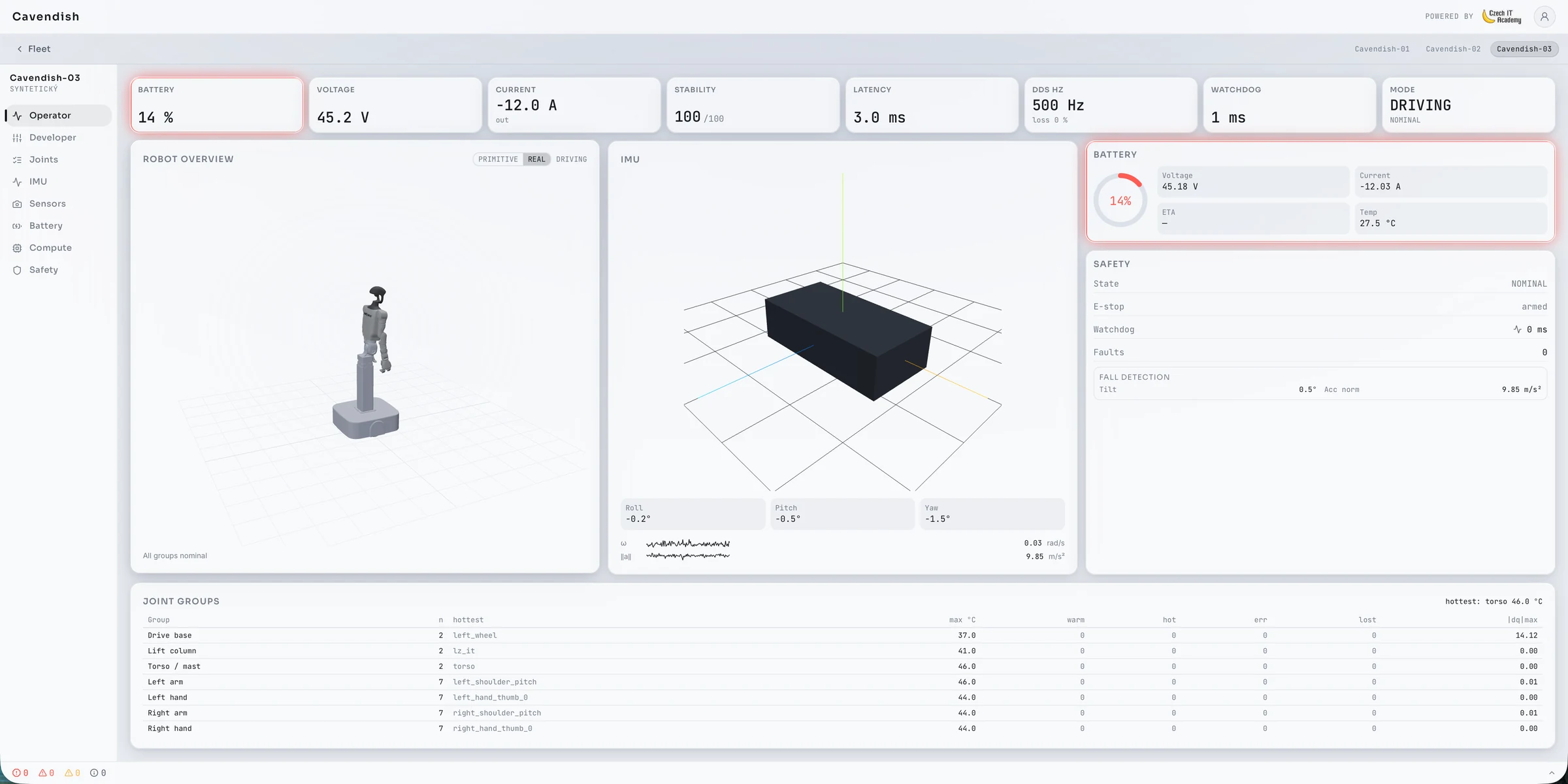
The safety panel in our app: E-stop status, watchdog, fall detection.
5What we need from you
Four things. None of them is a surprise, but it is better to know them in advance than halfway through the deployment.
- Access to the line's safety signals, so that the robot can be integrated into the station's safety circuit.
- A network connection for the control app and for sending telemetry.
- A step-free route to the station and between stations.
- Your own control room operator. We train them, but they are your employee.
Is anything left unanswered?
Send your questions in writing and we will answer in writing. There is no point bringing an engineer to a meeting for something that can be settled by e-mail.
- Send questions: https://www.cavendishrobots.com/en/contact
- What the technology cannot do: https://www.cavendishrobots.com/en/technology/limits